Quick answer: Most dog bites are predictable. Dogs signal discomfort long before they snap, using lip licking, yawning, whale eye, turning away, or a stiff freeze. In crowded Marina District spaces, ask before approaching, keep leashes short and loose, and give dogs room. If a scuffle happens, puncture wounds need prompt veterinary care because they seal over quickly.
Bites Are Usually the Last Step, Not the First
Almost every dog that bites has already said no several times. It just said no in a language most people were never taught to read. A dog will turn its head, freeze, move behind its owner, or offer a tight little lick of the lips, and when none of that works, it escalates. The bite looks sudden to us because we missed the first five sentences of the conversation.
That is genuinely good news. It means bite prevention is not about labeling certain dogs as dangerous. Risk sits with the individual animal and the situation it has been put in, not with a breed or a size or a coat color. It means that the same everyday habits, on the sidewalk, at the curb, outside a cafe, meaningfully lower the odds of a bad outcome for everyone.
Urban Pet Hospital sits on Lombard Street, and the Marina District is one of the most dog-heavy corners of San Francisco. Add Cow Hollow, Pacific Heights and Russian Hill to that and you get an enormous number of dogs sharing a small amount of ground. Narrow sidewalks, doorways, elevators, cafe patios, and shared green space where leashed and off-leash dogs mix all compress the distance between two animals who have never met. Distance is the main tool dogs use to keep themselves comfortable. City living takes that tool away.
The Early Signals People Miss
These are not aggression. They are the polite requests a dog makes before it gets louder. If you learn to recognize them, you get several seconds of warning that most people never notice.
- Lip licking. A quick flick of the tongue when there is no food anywhere. This is one of the most common and most overlooked signals.
- Yawning. A big, slow yawn from a dog who is clearly not sleepy usually means it is trying to defuse something.
- Whale eye. The dog keeps its head still but swivels its eyes toward you, showing a crescent of white at the edge. That white sliver is a strong request for space.
- Turning away. Head turn, shoulder turn, or a full body swivel to break off contact. The dog is trying to leave a conversation you are still having.
- The freeze. Movement stops. The body goes stiff and still, weight forward, mouth closed tight. A freeze is the most serious signal on this list and the one people most often read as calm.
- Slow, low tail movement. A wagging tail is not consent. A stiff tail held high with a short, fast twitch, or a low tail with a tense sweep, is not a happy tail.
- Displacement behavior. Sudden sniffing of the ground, a shake-off as if wet, or scratching that comes out of nowhere. These are stress spilling over.
The rule of thumb worth carrying around: when you see two or more of these at once, the dog has already asked twice. Increase the distance. Do not reach in, do not lean over, and do not talk the dog into it.
Pain Changes What a Dog Will Tolerate
A dog that has always accepted a hand on its head and suddenly does not is telling you something. Pain lowers tolerance, and much of the pain dogs carry is invisible from the outside. Sore joints, an ear that hurts, and untreated mouth pain all shorten a dog’s fuse, especially around the face and head. Oral pain in particular is easy to miss, which is exactly the point our post on why pet dental health matters makes: pets hide it well. If your dog has become touchy about its muzzle, collar or ears, that is a reason for an exam rather than a training correction, and professional dental care is often part of the answer.
Why “He Is Friendly” Goes Wrong on a Narrow Sidewalk
On-leash greetings between strange dogs are one of the highest-friction things we ask city dogs to do, and we ask it constantly. Here is why it fails so often.
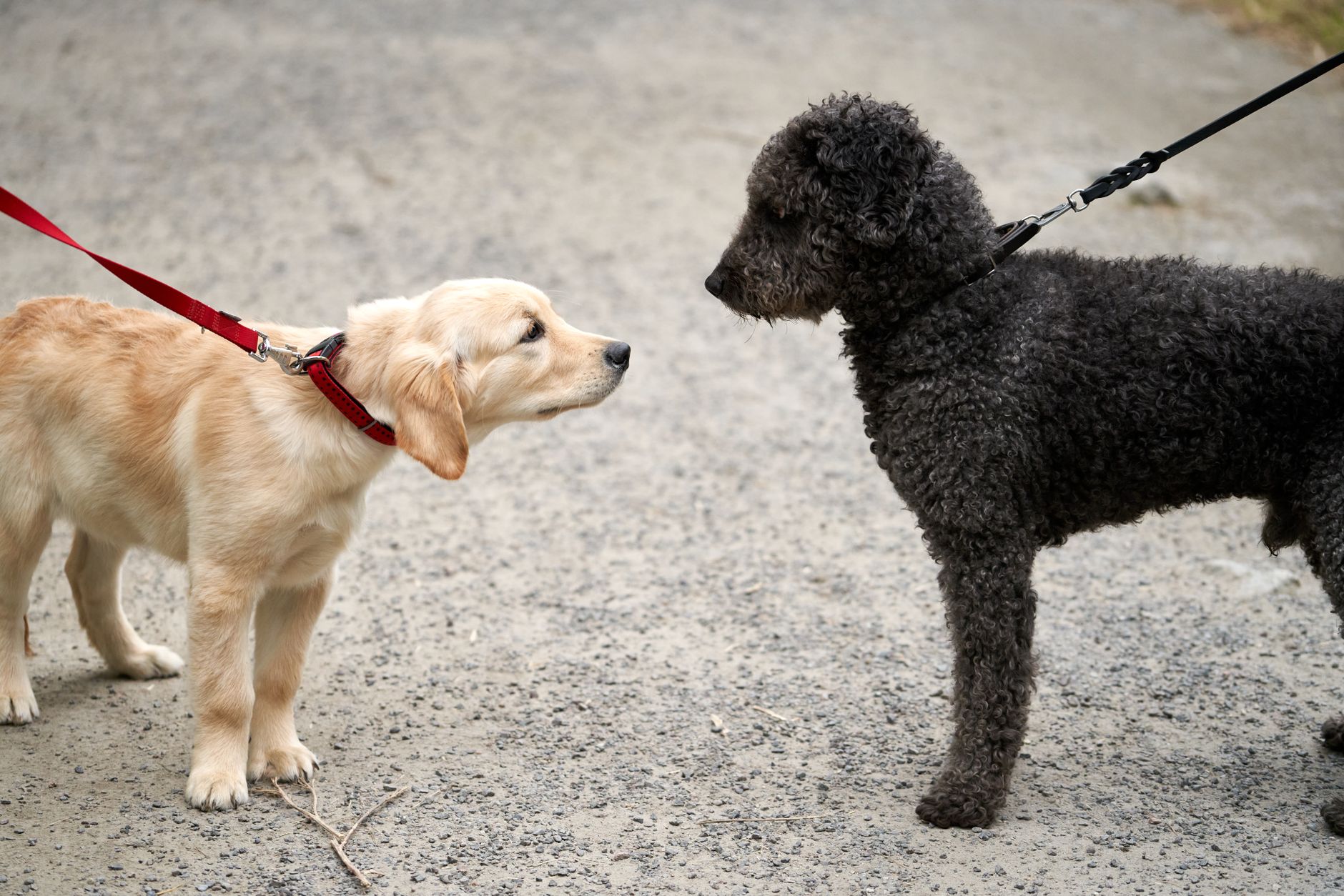
A leash removes the option to leave. Two loose dogs meeting in open space curve around each other, sniff briefly, and separate. Two leashed dogs on a Marina sidewalk are pulled straight at each other, head-on, at close range, with an owner on each end adding tension through the line. That is a rude greeting in dog terms before anyone has done anything wrong. If one dog wants out, it cannot get out, and the only remaining option is to make the other dog back off.
Then there is the sentence itself. “He is friendly” is usually said by someone whose dog is already at the end of a long leash and heading toward a dog they have never met. It describes one dog. It says nothing about the other one, who might be recovering from surgery, may be an anxious rescue in week two, or may simply be a dog that does not enjoy strangers. Friendly is not a password that overrides consent.
The better default is simple: dogs on leash pass each other. They do not meet. A calm walk past at a few feet of distance is a complete, successful interaction. If both owners want a greeting, the ask is short and specific, and either person can say no without it being rude.
How to Ask, and How to Teach Children to Greet
Ask the human, then ask the dog. Both steps matter, and the second one is the one adults skip.
- Stop at a distance and ask the owner directly whether their dog would like to say hello. Wait for a real answer, not a shrug.
- If yes, stand still, turn slightly sideways rather than square on, and let the dog come to you. A dog that chooses to close the gap is a dog that consented.
- Keep your hands low and let the dog sniff. Reaching over the head, hugging, and leaning over a dog’s shoulders are all things dogs commonly dislike and rarely enjoy from a stranger.
- Pet for about three seconds, then stop and see what happens. If the dog leans in or nudges your hand, carry on. If it moves away, turns its head, or freezes, the greeting is over and that is a fine outcome.
Children need a shorter, firmer version, because a child’s face is at dog height and a child’s instinct is to hug. Teach three rules and repeat them until they are automatic. Always ask a grown-up first, every single time, even for a dog you know. Never approach a dog that is eating, sleeping, in a crate or car, tied up outside a shop, or with puppies. Never hug, kiss, climb on, or chase a dog, including your own. Then supervise directly rather than from across the room, because children and dogs both move faster than adults expect. Early positive exposure to gentle handling matters on the other side too, which is the same principle we cover for cats in our guide to kitten-proofing a San Francisco apartment.
Leash and Equipment Habits That Reduce Conflict
Equipment will not fix a behavior problem, but the wrong setup creates conflict out of nothing.
- Keep the line short and loose in tight spaces. A short leash with slack in it gives you control without transmitting tension. A tight leash tells your dog something is wrong before it has decided anything.
- Retractable leashes are a poor fit for a crowded sidewalk. They let a dog reach a stranger, a stroller or another dog before you can intervene, and the thin line is hard for other people to see.
- Use a well-fitted harness or flat collar. Choking at the moment two dogs meet adds discomfort to an already tense situation and can build a negative association with the sight of other dogs.
- Watch the pinch points. Doorways, elevators, stairwells, blind corners and the gap between parked cars are where surprise meetings happen. Slow down and take the outside line.
- Give visible space to dogs wearing yellow, a bandana, or a vest asking for room. Many owners of dogs who need distance mark them deliberately.
- Bring your dog in and out on lead in shared green space. Around places like Crissy Field, where leashed and off-leash dogs share ground, check posted signage for the area you are actually standing in and leash up near paths, parking and picnic areas.
Keeping records current matters more than most owners realize after any incident. Up-to-date vaccinations and microchipping make the aftermath of a scuffle far less complicated, and a microchip is what gets a dog back to you if it slips a collar and bolts.
What to Do If a Scuffle Happens
First, do not reach between two dogs. Hands and faces in the middle of a fight is how people get seriously hurt. Make a loud, sharp noise, use a barrier such as a bag, a jacket or a trash-can lid, and if you must move a dog physically, move it by the back legs or hips and keep your body out of the space between them. Then separate fully, get both dogs out of sight of each other, and give everyone a minute before you assess anything.
Once things are calm, take the injuries seriously even when they look trivial. A dog’s canine tooth makes a small entry hole and does a lot of damage under the skin, crushing and tearing tissue on the way in. The skin then closes over within hours and seals bacteria from the other dog’s mouth into a warm pocket. That is why a puncture that looks like a scratch on Saturday can turn into a swollen, painful abscess by Tuesday. Wounds around the neck, chest and abdomen deserve particular caution because of what sits beneath them.
Please do not clean, flush, cut hair away from, or dress a puncture at home, and do not give your dog anything from your own medicine cabinet. Many human medications are dangerous to dogs, and home treatment can seal contamination in rather than let it out. Have the wound looked at instead. Our urgent care team sees bite wounds and lacerations during clinic hours, seven days a week from 8am to 8pm, and calling ahead lets the team get ready before you arrive. Deeper wounds sometimes need exploration, drainage or closure, which is where surgical services come in. If a scuffle happens after the clinic has closed for the night, go to the nearest emergency veterinary hospital rather than waiting for morning.
If a dog bites a person and breaks the skin, that is a matter for human medicine. Contact a physician or an urgent care clinic for people the same day. A veterinary clinic cannot treat a human injury. Exchange contact details with the other owner while you are both still there, and take photographs of the injuries before any swelling changes what they look like.
Finally, treat one incident as information rather than a verdict on your dog. Note what happened just before it: the space, the approach angle, whether food or a toy was present, whether your dog had already signaled and been overruled. That pattern is what a veterinarian or a qualified trainer works from. If you are raising a young dog and want the groundwork on introductions and leash habits, our puppy first-year guide covers the early stages in more detail.
Frequently Asked Questions
What is the earliest sign a dog wants me to back off?
Usually lip licking or a head turn. Both happen within a second or two of a dog becoming uncomfortable and both are easy to miss. Whale eye, where the dog holds its head still and shows white at the corner of the eye, is a clearer request for space. A stiff freeze is the most serious warning on the list.
Should I let my dog greet other dogs on leash?
As a default, no. Passing calmly at a few feet of distance is a successful interaction. Leashes prevent the curving, brief approach that dogs use naturally, and pull them into head-on contact at close range instead. If both owners agree to a greeting, keep it to a few seconds and separate before anything tightens.
How do I teach my child to greet a dog safely?
Three rules, repeated until automatic. Ask a grown-up first, every time, even with a familiar dog. Never approach a dog that is eating, sleeping, confined, tied up, or with puppies. Never hug, kiss, climb on, or chase a dog. Supervise up close rather than from across the room, since a child’s face sits at dog height.
My dog has a small puncture from a scuffle. Does it really need to be seen?
Yes, promptly. Puncture wounds are deceptive: the surface hole is small, the damage underneath is not, and the skin seals over within hours and traps bacteria inside. Please do not clean or dress it at home. Have it examined during clinic hours, or at the nearest emergency veterinary hospital if the clinic has closed for the night.
Does a dog’s breed tell me how likely it is to bite?
No. Bite risk comes from the individual dog and the situation it has been placed in, including pain, fear, crowding, and whether earlier signals were ignored. Reading body language and giving space works with every dog you meet. Assumptions based on appearance do not, and they cause people to relax around dogs who are actively asking for room.
My dog has suddenly become touchy about being handled. What should I do?
Book an exam before you change your training. A dog that newly objects to having its head, ears, mouth or body touched is often uncomfortable, and pain of any kind shortens tolerance. A veterinarian can look for a physical reason first, which is the right order. Behavior work built on top of unaddressed pain rarely holds.