
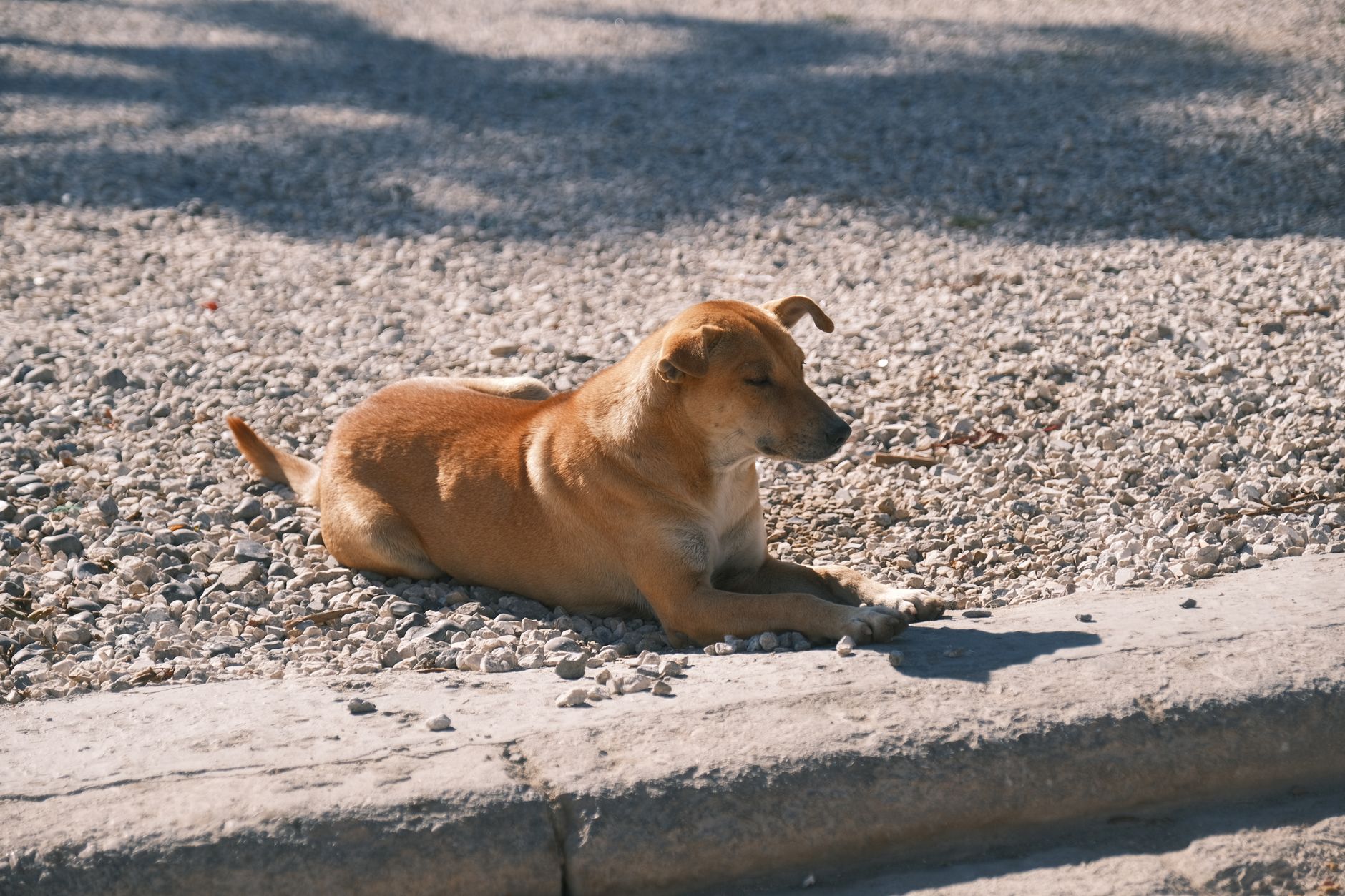
The story is nearly always the same. The dog jumped off the couch, or turned sharply after a ball on the Marina Green, and came up holding a back leg off the ground. It looks like an accident, and owners describe it that way. In most dogs it is not an accident at all, and understanding that changes what happens next.
The ligament was already failing
The cranial cruciate ligament sits inside the knee and stops the shin bone sliding forward under the thigh bone. In people it usually tears from a single violent injury, which is why the ski-accident version is the one everybody has in their head.
In dogs it is mostly different. The great majority of cruciate ruptures are the end point of a slow degeneration that has been going on for months or years. The ligament frays, weakens, and then finally gives way during something entirely ordinary. The jump off the couch was not the cause; it was the last straw.
That matters for three practical reasons. It explains why a dog with no history of trauma can be suddenly three-legged. It explains why partial tears exist and tend to progress rather than heal. And it explains the statistic owners find hardest to hear: because the same degeneration is usually happening in both knees, somewhere between a quarter and a half of dogs who rupture one cruciate go on to rupture the other. Studies differ on the exact share, which is why that range is wide rather than a single number, but the risk is real and it is worth planning for rather than being surprised by.
What it looks like
- Sudden hind-limb lameness, often holding the leg completely off the ground at first.
- Improvement over a week or two, to toe-touching or a limp. This is where owners conclude it is healing. The ligament has not healed; the dog has adapted.
- Sitting with the leg out to one side rather than tucked underneath. This is one of the most useful signs and it persists.
- Stiffness after rest that loosens with movement.
- A click or pop when walking, which can mean the cartilage pad inside the joint has been damaged too. That happens often alongside a cruciate tear and changes what is needed.
- Muscle loss on the affected thigh, visible within weeks as the leg is used less.
- In a partial tear, a limp that comes and goes with activity for months before anything dramatic happens.
Diagnosis is mostly hands rather than imaging. The knee is tested for a specific forward slide, and because a tense dog can mask it, that examination is often done under sedation to be conclusive. Radiographs then show what the joint already looks like and rule out the other causes of a sore hind leg, which in an older dog include things that have nothing to do with ligaments.
Where a surgeon changes the answer
This is the part worth being straight about, because the honest answer depends on the dog.
Small, light dogs sometimes do acceptably with a managed, non-surgical approach: strict activity restriction for a long stretch, weight control, and a structured return to exercise. It is not a quick route and it is not right for every small dog, but it is a legitimate option.
For medium and large dogs, and for active dogs of any size, surgical stabilization gives a better and faster return to function. The procedures we use change the mechanics of the joint so the knee no longer depends on the ligament that is gone, and the choice between them depends on the dog’s size, conformation, age and what else is going on inside the joint.
Our surgical services are led by a board-certified small animal surgeon, which means this conversation happens here rather than becoming a referral and a wait. It also means the cartilage damage that often accompanies a cruciate tear gets addressed at the same time, along with the pain plan and the written recovery instructions either side of surgery. In-house imaging, plus a sedated examination where a tense dog is masking the joint, is how we establish what is actually torn and how much.
Whatever route is chosen, two things do the heavy lifting afterwards and neither is glamorous: controlled activity for the full recommended period, and getting the weight off if there is weight to lose. An overweight dog recovering from knee surgery is working against themselves at every step.
What to do in the first few days
- Stop the free running now. No stairs taken at speed, no jumping into cars, no off-leash sprinting. A partial tear becomes a complete one this way.
- Short leashed bathroom breaks only, until you have been seen.
- Do not give anything from your own cabinet. Several common human pain remedies are genuinely dangerous to dogs and some are worse in cats.
- Put runners down on slick floors, especially at the bottom of stairs.
- Write down what you saw, including whether the leg came up suddenly and whether it improved. That history separates a cruciate from the alternatives.
- Come in rather than waiting out the improvement. The improvement is the trap.
Our hours
We are open every day from 8:00 am to 8:00 pm, including weekends, and we take urgent cases throughout. Being open seven days means you do not have to choose between waiting until Monday and driving across the Bay.
A sudden lameness is not usually a middle-of-the-night emergency, and our hours cover it comfortably through urgent care. A dog who will not settle, cries out when the leg is touched, has a limb at an odd angle, is bleeding, or was hit by a car is a different matter and needs a 24-hour emergency hospital if we are closed.
Common questions
Will it heal on its own if we rest him?
A torn cruciate does not reattach. What rest achieves is a dog who compensates, with the joint continuing to degenerate underneath. For small dogs that compromise is sometimes acceptable; for larger dogs it usually is not.
My dog is nine. Is that too old for surgery?
Age is not the deciding factor. Organ function, heart and lungs, body condition and what else is going on are, and those are things we assess rather than guess from a birthday. Plenty of nine-year-olds do very well.
How long is the recovery?
Expect two to three months of genuinely restricted activity with a graded return after that, and the restriction is not optional. Most of the surgical failures we see are activity failures.
Should I do something about the other knee now?
Not surgery, no. What helps is keeping the weight down and the muscle on, and knowing the signs so you catch the second one early if it happens.
Do cats tear cruciates?
Rarely, and when they do it is more often genuine trauma than degeneration. A limping cat is more likely to be something else, and worth examining rather than assuming.
Speak to the team at Urban Pet Hospital
If your dog came up lame on a back leg, keep them leashed and quiet and book a look this week. If the limp has improved, that is not a reason to cancel — it is the usual course of a tear.
Published by the team at Urban Pet Hospital.
This article is educational in nature and is not a replacement for hands-on assessment of your own pet by a veterinarian.
Urban Pet Hospital
2308 Lombard Street, San Francisco, CA 94123 (Marina District)
Phone: (415) 400-5754
Hours: Open 7 days, Monday to Sunday 8:00 am to 8:00 pm